Core Components of Microservices
Contents
In a microservices architecture, the independence and distributed nature of services bring a range of technical and operational challenges. This article takes a close look at the seven core components that make up a microservices ecosystem: service discovery, service invocation, distributed tracing, configuration center, API gateway, service protection, and service monitoring and alerting. These components are key to keeping a microservices architecture efficient and stable. Service discovery lets service instances find and talk to each other; service invocation covers how services interact and which protocols they use. Distributed tracing helps us understand call relationships between services and locate performance bottlenecks. The configuration center gives services dynamic configuration, while the API gateway acts as the system’s entry point, handling request routing and security. Service protection and monitoring safeguard reliability and observability. After reading this article, you will have a more complete picture of the core components of a microservices architecture and how to use them effectively in practice.
Service Discovery
In a microservices architecture, service discovery is the process by which a service consumer, when it needs to interact with another service, automatically looks up and obtains the network address of the service provider. It usually relies on a central registry: service instances register themselves on startup, and consumers query the registry to find providers. This mechanism enables dynamic decoupling and communication between services and is key to high availability and scalability in a microservices architecture.
There are two main service discovery patterns: client-side discovery and server-side discovery.
Client-Side Discovery
On startup, each microservice registers its metadata with the registry, including its network address, service name, tags, and so on. When a client needs to call a service, it first checks its locally cached list of service nodes. If the list is available, the client picks a node according to the configured load balancing strategy. The strategy can be round-robin, random, or least connections, so that requests are spread evenly across all available instances.
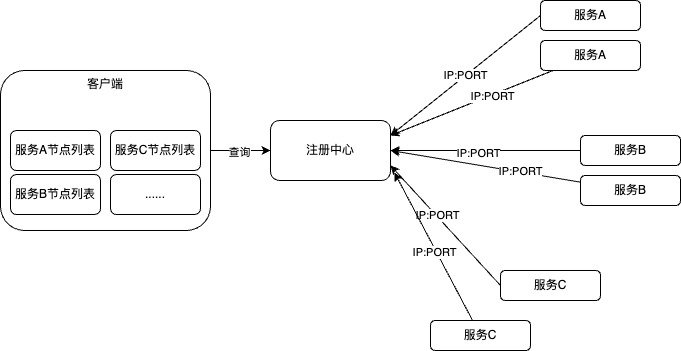
Clients usually subscribe to updates from the registry so they learn in real time when nodes come online or go offline. This way, nodes being added or removed are promptly reflected in the client’s cache. For example, Netflix Eureka is a widely used service registration and discovery mechanism: clients discover other service instances through the Eureka server, and client libraries such as Ribbon use that information for load balancing and failover.
The advantages of client-side discovery include lower coupling between services, since an instance does not need to know where other services are located and can communicate by service name alone. Clients can also implement whatever load balancing strategy they like. However, this pattern has its own challenges, such as added client complexity, since the client must handle the discovery logic.
To optimize service discovery, you can use health checks so that only healthy instances are registered and discovered, and implement heartbeats to keep service information up to date. Clients can also cache the instance list and refresh it when needed, reducing dependence on the registry and improving call efficiency.
Server-Side Discovery
In contrast to client-side discovery, in server-side discovery the work of locating instances and balancing load is handled by a centralized component, usually a load balancer or an API gateway. In this pattern, clients do not talk to the registry directly; they reach services indirectly through the load balancer.
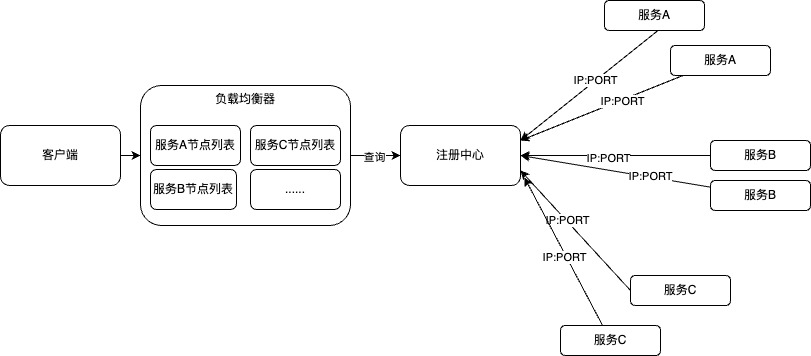
By moving the complexity of service discovery from the client to the server side, this pattern brings clear advantages. Clients become much simpler, since they no longer need their own discovery logic or a list of providers. A client just sends requests to the load balancer, which handles discovery and routing from there. This centralized approach makes service governance, monitoring, and updates more consistent and efficient, and it provides a uniform discovery strategy across programming languages and frameworks. In addition, as the single entry point for requests, the load balancer improves security by centralizing policies such as authentication, authorization, and encryption, and it can apply more effective caching strategies to optimize global request patterns.
However, server-side discovery also has drawbacks. The first is performance: every request must pass through the load balancer or API gateway, and the extra network hop can add latency. In addition, the server-side component can become a bottleneck or a single point of failure, although deploying multiple instances reduces this risk.
Service Invocation
Service invocation is how different services in a microservices architecture communicate and exchange data. It is typically implemented with HTTP/RESTful APIs, RPC, message queues, and similar technologies, supporting synchronous or asynchronous interaction and keeping the system modular and scalable.
HTTP/RESTful API
The RESTful API pattern is built on HTTP. By defining a set of resources and the operations on them, it provides a simple yet powerful invocation mechanism. Each resource is identified by a unique URI (Uniform Resource Identifier), and HTTP methods (GET, POST, PUT, DELETE) are used to retrieve, create, update, and delete those resources. The client interacts with the server by sending HTTP requests, and the server processes each request based on its method and resource path and returns a response body.
Thanks to its simplicity, statelessness, cacheability, cross-platform nature, and rich tooling, the RESTful API has become the preferred way for services to communicate in a microservices architecture. HTTP is ubiquitous and easy to use, which makes APIs easy to understand and implement, while statelessness keeps each request independent and makes horizontal scaling straightforward. Built-in HTTP caching reduces network traffic and speeds up responses. On top of that, RESTful APIs work across languages and platforms, and the large number of ready-made tools and libraries has further driven their adoption in microservices.
Because of how HTTP is designed, using it for service invocation in microservices also poses challenges. First, while statelessness helps scalability, every request must carry the necessary context again, which can become a performance bottleneck when requests are frequent. Second, HTTP headers and message structure can add significant communication overhead, especially under high load, which can slow down service calls.
Security is another key concern with HTTP/RESTful APIs. HTTPS can encrypt data in transit, but certificate management, key exchange, and similar measures require extra configuration and maintenance. Also, the flexibility of RESTful APIs gives designers freedom, but it can lead to inconsistent API designs that make APIs harder for clients to understand and use.
RPC
RPC (Remote Procedure Call) plays a vital role in microservices architecture: it lets services communicate as naturally as calling a local function. RPC frameworks hide the details of network transport behind a simple programming model, so developers can focus on business logic instead of how data moves across the network.
The core advantage of RPC is that it offers a uniform interface across programming languages, making service calls language-agnostic. This cross-language capability gives teams much more flexibility to choose the technology stack best suited to a particular problem. In addition, RPC usually uses binary data formats, which serialize and deserialize more efficiently than text-based protocols, reducing network latency and improving overall system performance.
RPC frameworks also provide synchronous calls, an important feature for business logic that must wait for a service’s response. Synchronous calls simplify the programming model and let developers write code in a traditional style. Many RPC frameworks (such as Dubbo) also have advanced features built in, such as service discovery, load balancing, the circuit breaker pattern, rate limiting, and circuit breaking, which together improve the stability and reliability of distributed systems.
When implementing RPC, developers need to design service interfaces carefully and choose a suitable communication protocol and serialization mechanism. Service interfaces are usually defined with an IDL, which specifies the service’s methods and data types. The right communication protocol is critical for performance and compatibility, and an efficient serialization mechanism reduces the overhead of sending data over the network.
Despite its benefits, RPC has some drawbacks in practice. For example, RPC frameworks can constrain your choice of technology stack, since the client and server usually need to use the same framework and protocol. Debugging RPC is also usually harder than debugging local calls, because it involves network communication and the other problems of distributed systems. And as services evolve, interface versioning and compatibility become issues that designers have to address.
Message Queues
The message queue pattern is a key asynchronous communication mechanism in microservices architecture. It lets services decouple from each other and process tasks asynchronously by passing messages. As middleware, a message queue system offers an efficient and reliable way to handle communication between services, especially in high-concurrency, high-throughput scenarios.
The core advantage of message queues is asynchronous processing. In traditional synchronous communication, the caller must wait for the provider’s response, which wastes resources and reduces efficiency when the provider is slow or under heavy load. With a message queue, the caller sends the request as a message to the queue and immediately moves on to other work without waiting for a response. The provider takes messages off the queue and processes them asynchronously when it is ready, which greatly improves the system’s throughput and responsiveness.
Message queues also provide strong decoupling. In a microservices architecture, dependencies between services are often very complex. With a message queue, services no longer call each other directly but communicate by exchanging messages. This lets services be developed, deployed, and scaled independently without being affected by other services. Message queues also support broadcast and publish/subscribe patterns, making it easier to build an event-driven architecture.
Another important property of message queues is reliability. Many message queue systems offer persistence so that messages are not lost when the system fails. They also provide acknowledgment and retry mechanisms to make sure messages are processed correctly; even if the provider fails to process a message, it can be retried or moved to a dead-letter queue for special handling.
When implementing message queues, designers need to consider message format, queue topology, routing strategy, and exception handling. Message formats usually need to follow a defined specification so that messages can be parsed correctly across services. Queue topology may be point-to-point, publish/subscribe, or something more complex, and designers should choose based on business needs. Routing strategy concerns how messages get from producers to consumers, which can involve queue selection, message filtering, and distribution.
Despite these advantages, message queues have limitations. First, they are generally used for asynchronous service calls, which limits where they can be applied. Second, introducing a message queue increases system complexity and requires extra management and maintenance. Message ordering, transactions, and eventual consistency are also issues designers need to consider. Finally, the performance and scalability of the message queue are key factors, and designers need to choose a system that meets their business requirements.
Distributed Tracing
In a microservices architecture, the complexity of service calls grows significantly with the number of services. A single user request may involve multiple services, which may run on different servers or even in different geographic locations. Distributed tracing has therefore become a key technique for understanding and monitoring calls between services.
The core goal of distributed tracing is to monitor and diagnose how requests execute in a distributed system. By recording the path a request takes through the system, it helps developers and operators quickly locate performance bottlenecks, troubleshoot failures, and optimize the system. A tracing system usually consists of a tracer, a trace context, and centralized storage. The tracer records the execution path and metrics of a request, the trace context carries tracing information as the request is passed along, and centralized storage collects and analyzes the trace data.
Under the hood, distributed tracing generates a unique Trace ID for each request and creates a Span at each service node that records the details of each operation, forming the complete request path. Span and Trace are the fundamental concepts: a Trace represents a complete request path, and a Span represents a single unit of work within a Trace. Context propagation is the key process that ensures tracing information for a request is passed between services in a distributed system.
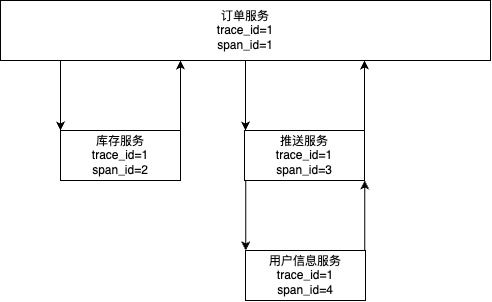
The importance of distributed tracing in a microservices architecture is self-evident. It not only helps developers locate problems quickly but also visualizes system performance, making it possible to optimize call relationships between services. Common tracing systems include Zipkin, Jaeger, SkyWalking, and OpenTelemetry. They provide powerful toolsets for collecting, storing, querying, and visualizing trace data.
Service Monitoring and Alerting
In a microservices architecture, service monitoring is critical to system stability and performance. As the system grows and the business becomes more complex, the number of services and their interactions become increasingly intricate, so you need an effective monitoring system to track service health and performance metrics in real time. Monitoring is essential for detecting problems early, optimizing performance, managing resources, auditing security, and gaining insight into business trends.
When monitoring services, you need to watch a set of key metrics: resource usage such as CPU and memory utilization, disk I/O, and network traffic; performance metrics such as response time and throughput; business metrics such as order volume and user activity; system logs and error messages; and the status of external services or third-party APIs your services depend on. These metrics not only reflect how services are running but also form the basis for quickly locating and resolving problems.
When metrics become abnormal, timely alerting is indispensable. The alerting system should notify the operations team quickly via email, SMS, or instant messaging, based on predefined thresholds and policies. To manage alerts effectively, you can aggregate them to cut down on duplicate or unimportant alerts. On receiving an alert, the operations team needs to respond quickly, confirm the problem, and take action, such as degrading the service, restarting it, or applying an emergency fix.
Implementing service monitoring involves choosing the right tools and platforms, which should provide real-time data analysis, visualization, alert management, and log analysis. As technology has evolved, many mature monitoring solutions have emerged, such as Prometheus, Grafana, and the ELK Stack, which provide powerful monitoring capabilities for microservices architectures.
Configuration Center
In a microservices architecture, as the number of services grows, managing configuration through traditional local config files becomes hard to maintain and scale. Introducing a unified configuration center is therefore a common solution. A unified configuration center manages configuration for all services in one place, making changes and maintenance easier, and supports dynamic updates without restarting services, improving the system’s flexibility and responsiveness. Configuration centers are also usually integrated with version control, making it easy to track the history of configuration changes and roll back, and they can provide different configurations for different environments (development, testing, production) to keep environments isolated.
Configuration centers can be implemented in many ways: storage backed by a database, a file system, a distributed coordination system such as etcd or Consul, or a cloud service. Some cloud platforms offer configuration management services, such as AWS AppConfig and Alibaba Cloud’s Nacos, which provide full configuration management features including storage, change notifications, and client SDKs. Companies can also build their own configuration center on open source technologies (such as Spring Cloud Config or Apollo) to fit their needs.
A configuration center usually has two parts: a server and a client. The server stores configuration, exposes CRUD interfaces for it, and notifies clients when configuration changes. The client communicates with the server, pulls configuration, and caches and applies it locally. A configuration center also needs a user interface for administrators to manage and publish configuration.
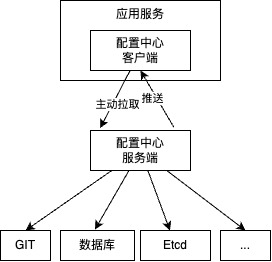
In practice, the choice and implementation of a configuration center should depend on specific business requirements, technology stack, and operational capabilities. A well-designed configuration center can greatly improve the maintainability and scalability of a microservices architecture.
API Gateway
In a microservices architecture, the API gateway is the front door of the system, managing all requests going into and out of the microservices. Its core responsibilities include request routing, load balancing, authentication, authorization, rate limiting, monitoring, and logging. By handling these cross-cutting concerns centrally, the gateway reduces the complexity of microservices and lets each service focus on its business logic.
An API gateway lets the system handle ingress traffic uniformly, improving security and maintainability. It can serve as a single point of authentication, ensuring that only legitimate requests reach backend services. It can also perform load balancing, distributing requests across service instances to improve availability and scalability.
An API gateway usually consists of a chain of filters, each executing specific logic at a different stage of request processing. For example, pre-filters can handle authentication and logging, while post-filters can transform response data and log it. This filter chain mechanism makes the gateway flexible to extend and customize.
API gateways can be built on a variety of technologies. Nginx is a high-performance HTTP server and reverse proxy that can be configured for routing and load balancing. Spring Cloud Gateway is built on Spring Boot and WebFlux; it supports a non-blocking, event-driven architecture and is well suited for reactive microservice gateways. Netflix Zuul is another popular microservice gateway with a rich feature set, but you should keep its performance and the state of its community support in mind.
The choice of API gateway should be based on the system’s specific requirements, technology stack, and performance needs. For example, Spring Cloud Gateway may be a better choice for systems that need high performance and a reactive architecture, while systems already using Nginx may choose to build their gateway on Nginx. Whatever technology you choose, the API gateway is an indispensable part of a microservices architecture, providing a stable, secure, and scalable entry point to the system.
Service Protection
In a microservices architecture, the API gateway gives the system a centralized entry point for shared cross-service concerns such as request routing, load balancing, and security. However, each microservice still needs its own protection, because the gateway mainly deals with requests at a macro level, while service-level protection calls for finer-grained control and business-specific logic.
Service-level protection is necessary because it allows fine-grained control over a service, which may be based on specific business rules and policies. For example, a service may need to restrict access based on a user’s role or permissions, which requires authentication and authorization inside the service. Service-level protection also helps isolate failures and prevents problems in a single service from spreading to the whole system.
Service protection includes rate limiting and circuit breaking. Rate limiting prevents overload by controlling how fast a service accepts requests. It can be implemented with various algorithms, such as fixed window counters, sliding window counters, the leaky bucket, and the token bucket. Rate limiting effectively keeps a service from being overwhelmed by malicious attacks or unexpected traffic spikes.
Circuit breaking is a mechanism that stops failures from cascading. When a service detects that it or one of its dependencies is failing, it can proactively “break” the connection and return an error response quickly, avoiding exhausting system resources. Circuit breaking is usually combined with the circuit breaker pattern, which has three states: open, half-open, and closed, enabling automatic recovery and fault isolation.
Service degradation is a strategy of temporarily turning off non-core features when the system is overloaded or some services are unavailable, so that core features keep working. For example, an e-commerce platform may switch off some complex recommendation algorithms during a promotion to keep core services such as ordering and payment stable.
Service authentication and authorization are key to ensuring that only legitimate users and systems can access a service. This typically involves security protocols such as JWT and OAuth2. Service-level authentication and authorization can provide finer-grained control than the API gateway.
Service monitoring and logging are essential for detecting and diagnosing problems promptly. This includes monitoring key metrics such as response time, error rate, and system load, as well as detailed logging of requests and responses.
In containerized and cloud-native environments, service isolation can be achieved with containers, virtual machines, or a service mesh. A service mesh such as Istio provides a way to apply fine-grained control and protection between services.
Summary
In the complex ecosystem of a microservices architecture, service discovery, service invocation, distributed tracing, the configuration center, the API gateway, service protection, and service monitoring and alerting are the core technical pillars that keep the system stable and performant. Service discovery and the registry let service instances register and find each other dynamically, while service invocation enables communication between services through RESTful APIs, RPC, or message queues. Distributed tracing reveals how requests flow across microservices, providing key information for performance tuning and troubleshooting. The configuration center manages service configuration centrally, simplifying environment differences and configuration changes. The API gateway, as the system’s front door, handles request routing, load balancing, and security. Service protection mechanisms such as rate limiting and circuit breaking keep services stable in the face of abnormal traffic or failing dependencies. Finally, service monitoring and alerting track service health in real time so that any anomaly is detected and handled promptly. Together, these technologies provide strong support for a microservices architecture, enabling it to adapt to ever-changing business requirements and technical challenges.